

As the world’s wealthiest country turns 250, it’s not about the Benjamins but the Elons. For the rest of us, can we still afford to age?
Hey, hooray, happy 250th America! We’d celebrate you longer but we’re covering the bigger headline: Elon Musk just became the world’s first trillionaire.
I have two questions: How will SpaceX affect my 401(k)—and just how big is a trillion? On the latter, imagine spending $1 million an hour, every hour. No sleeping, no bathroom breaks, no holidays. At that pace, burning through Musk’s $1.1 trillion takes you 126 years. Now point that same money cannon at U.S. healthcare. America spent $5.3 trillion total on healthcare in 2024. At that same $1 million an hour, it would take 605 years.
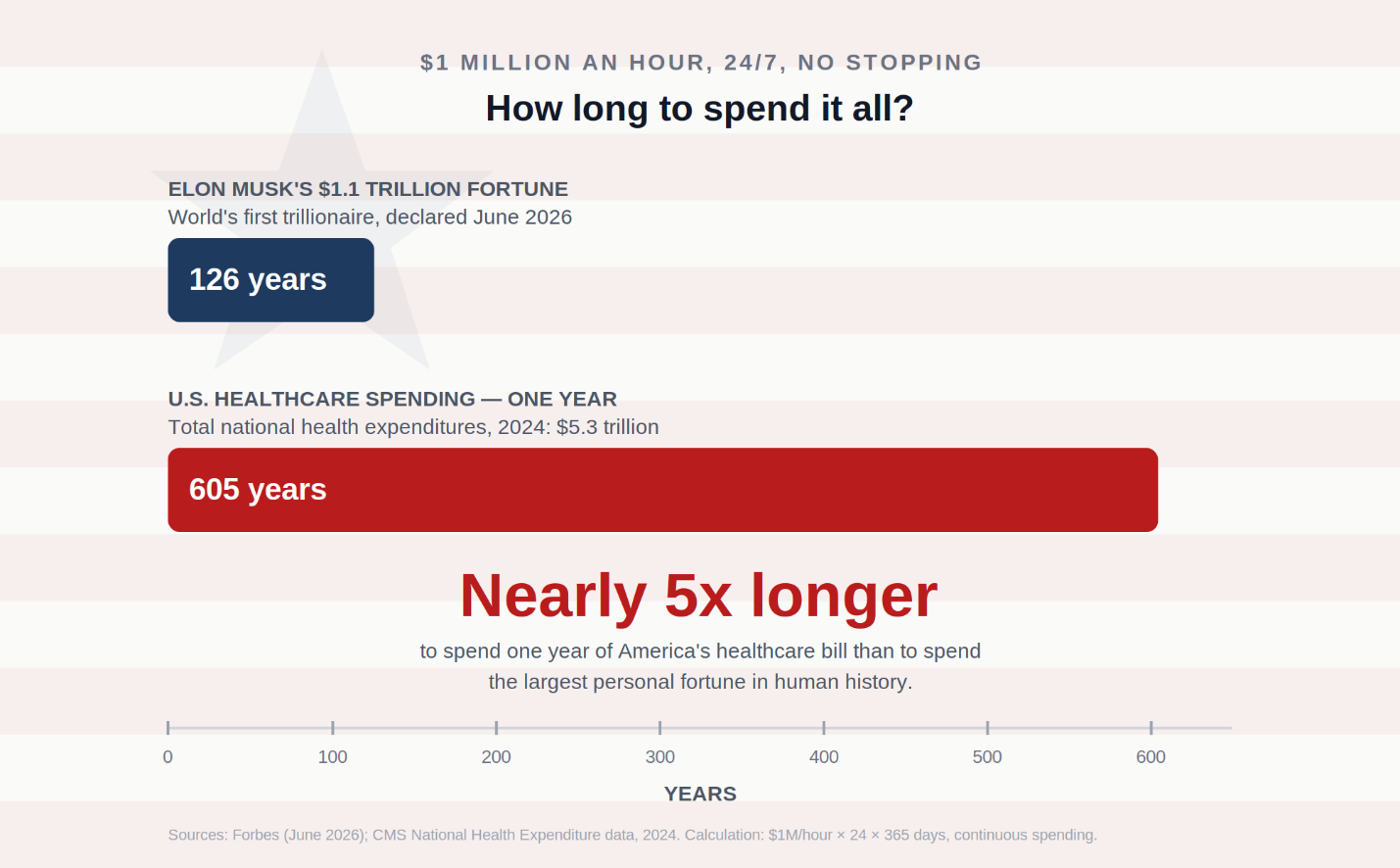
Yep. It takes nearly five times longer to spend down one year of America’s healthcare bill than to spend the largest personal fortune in human history. A trillion dollars just rewrote the record books. Healthcare spends that like pocket change.
Healthcare: Putting the ‘gross’ in our GDP
Federal spending in FY 2025 hit $7.01 trillion—about 23% of our $30.76 trillion economy. The headliners:
- Social Security: ~$1.6 trillion (22.5% of the budget, 5.2% of GDP)
- Healthcare programs (Medicare, Medicaid, ACA subsidies): ~$1.8 trillion (roughly 25% of the budget, 5.8% of GDP)
- Interest on the national debt: ~$970 billion (14% of the budget, 3.2% of GDP) — and yes, debt service just blew past defense. That’s new. That’s not a typo.
- National defense: ~$917 billion (13% of the budget, 3.0% of GDP)
- Everything else: education, transportation, veterans’ benefits, food assistance, fighting over the leftovers
The budget for fighter jets, aircraft carriers, and global military dominance doesn’t even crack a trillion dollars. It’s a fifth of what we spend keeping people alive.
And that $1.8 trillion is just the federal government’s tab. Zoom out to total national health spending—private insurance, employer plans, your copay, all of it—and the total is a staggering $5.3 trillion, or 18% of the entire GDP.
How did we get here?
As the largest segment of largest economy of history in world, healthcare must be feeling so seen.
Paradoxically, it’s the only price tag in American life that you know is expensive in general but don’t know the actual cost until you get the bill. Kinda like seafood at market price.
Blame the architecture. We stitched this patchwork system together over the last 80 years, starting with a very different life expectancy and a very different idea of what medicine could do. Today, it’s not looking so good.
At the same time that Mexico has announced a plan for free universal healthcare, and millions are dropping out of the ACA Marketplace because it’s no longer affordable without subsidies. Something’s got to give.
What do we do now?
It’s not that we don’t know how to tighten the belt.
After all, the Big Beautiful Bill will cut $1 trillion from Medicaid—the size of Elon’s fortune and almost exactly what the BBB will also provide the top 1% in tax cuts.
It’s just that we don’t know how to stop our spending. America’s bar tab is so big that in March, the Treasury declared the U.S. insolvent. And healthcare is one of our biggest line items.
Surviving our next Terrible Twos
In 1984, Ronald Reagan announced that it was morning again in America. Employment and new home sales were up, interest rates and inflation were down. U.S. health spending was $387 billion and declining slightly as a percentage of GDP.
In 2026, America feels closer to midnight. Roughly a quarter of all Medicare spending happens in someone’s final year of life.
We’re pouring a staggering chunk of the national health bill into care that, definitionally, can’t deliver the thing healthcare is supposed to be for. Our golden age of medicine needs a golden age of affordable coverage and responsible spending or we’ll simply be helping all but a chosen few live longer and poorer.
To talk more about this blog, reach Dan here. While you’re at it, learn about Sage’s capabilities, and set up an intro conversation with our team.